G-BOAW has a particularly interesting history because it was one of the Dash 7s introduced by London City Airways in 1988. It subsequently flew with British Midland Airways, Widerøe in Norway and Berjaya Air in Malaysia.
1. Original aircraft details
| Detail | Information |
|---|---|
| Manufacturer | de Havilland Canada |
| Aircraft type | DHC-7-110 Dash 7 |
| Construction number | 110 |
| First flight | 1988 |
| Original test registration | C-GFBW |
| British registration | G-BOAW |
| Engines | 4 × Pratt & Whitney PT6A-50 |
| Passenger aircraft | 50-seat class |
AirHistory+1
2. London City Airways (1988–1990)
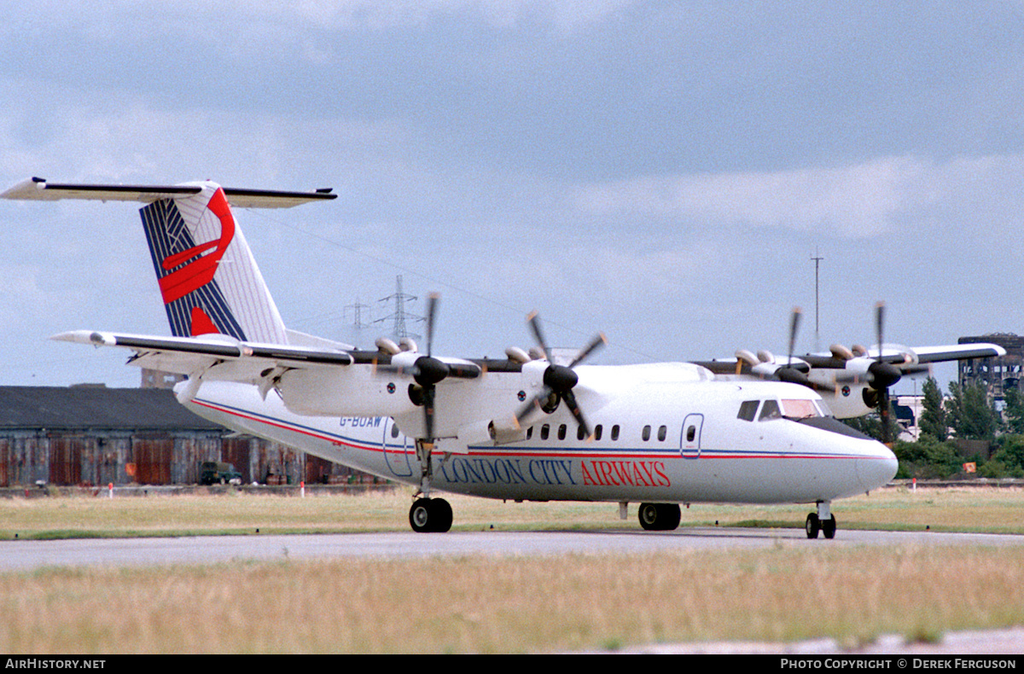
The aircraft first flew in 1988 as C-GFBW before being delivered new to London City Airways.
It was registered G-BOAW on 13 April 1988.
London City Airways operated the aircraft from London City Airport, using the Dash 7’s excellent short take-off and landing performance.
An interesting incident occurred on 30 April 1988 at London City Airport.
While another Dash 7, G-BRYB, was manoeuvring from its parking stand, its left wing struck the right aileron of G-BOAW, which was parked nearby.
The damage to G-BOAW was recorded as a bent right aileron.
3. British Midland Airways (1990–1992)
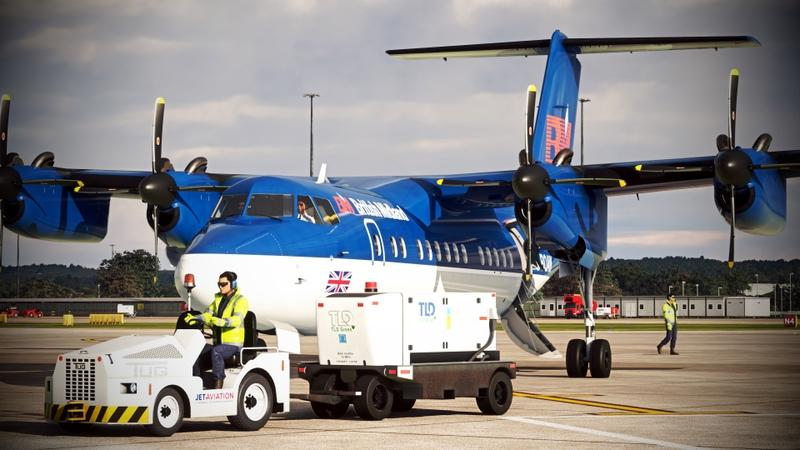
On 1 September 1990, London City Airways merged into British Midland Airways.
G-BOAW subsequently became part of the British Midland operation.
A notable photograph shows the aircraft at London Heathrow on 12 May 1991 wearing British Midland colours. AirHistory+1
4. The January 1991 incident
Crash of a Fokker F27 Friendship 200 in East Midlands | Bureau of Aircraft Accidents Archives
One of the most significant events in the aircraft’s history occurred on 30 January 1991.
While flying from Brussels to London City Airport, G-BOAW experienced a sudden, uncommanded nose-up pitch movement shortly after take-off.
The crew discovered a serious pitch-control problem affecting both autopilot and manual flying.
They declared an emergency and diverted to London Stansted Airport.
The aircraft successfully completed a flapless landing.
The incident was investigated by the Air Accidents Investigation Branch (AAIB), which published report 3/1992.
Original investigation: AAIB Report 3/1992 – G-BOAW.
5. Widerøe – Norway (1992–1995)
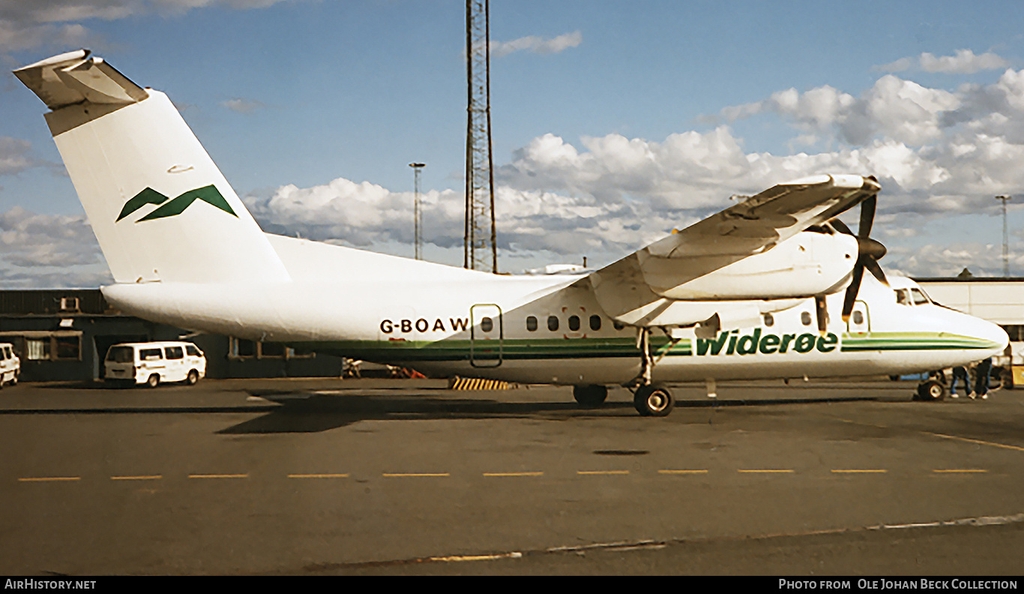
On 1 October 1992, the aircraft was leased to Widerøe in Norway.
It continued initially using its British registration G-BOAW.
On 18 June 1994, it was re-registered LN-TAW.
Widerøe used the Dash 7 on Norwegian regional services, where its short-field capabilities were especially valuable.AirHistory.net #795045
6. Berjaya Air – Malaysia (1995 onwards)
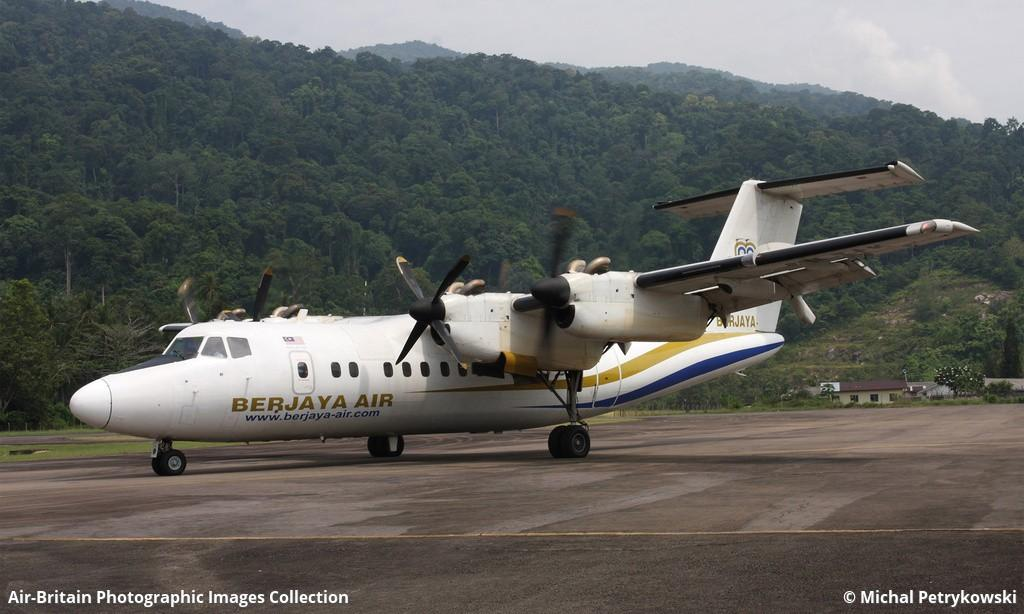
In April 1995, the aircraft left Widerøe and returned to the British ownership group.
On 20 April 1995, it was registered 9M-TAK and joined Berjaya Air in Malaysia.
It subsequently operated in Malaysia, including services associated with the country’s island resorts.
It was eventually withdrawn from service and stored at Kuala Lumpur-Subang around 2014–2016.
In 2019, it was dismantled and shipped to Shijiazhuang Engineering Vocational College in Hebei, China, for use as an instructional airframe.
7. Complete registration history
- C-GFBW Manufacturer test registration – Canada, 1988
- G-BOAW London City Airways – 1988
- G-BOAW British Midland Airways – 1990
- G-BOAW Widerøe – October 1992
- LN-TAW Widerøe – June 1994
- 9M-TAK Berjaya Air – April 1995
- 2019 Dismantled and transported to China for educational use
8. Original photographs and records
These are particularly useful references: